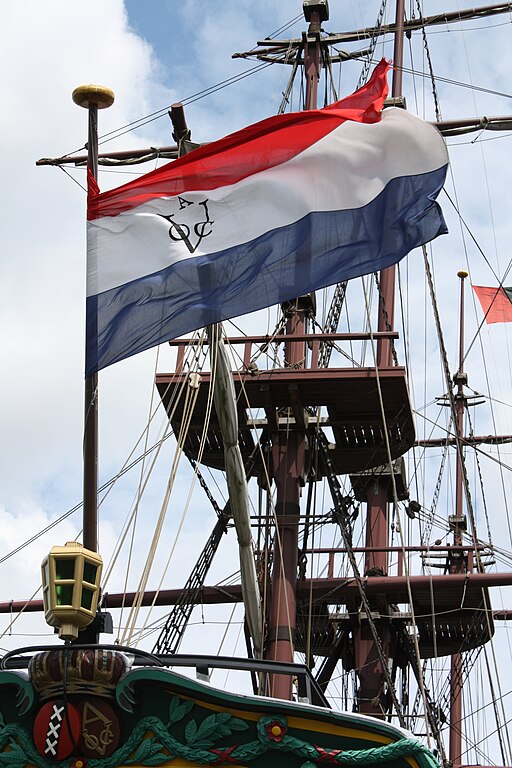
Verenigde Oostindische Compagnie
Founded in 1602 as a joint stock company with capital amounting to almost 64 million Dutch florins, the United Dutch East India Company (Verenigde Oostindische Compagnie, hereafter the VOC) received a monopoly of Dutch trade and navigation east of the Cape of Good Hope and west of the straits of Magellan. The new corporation was subdivided into six regional chambers (kamers) in the former seats of the pioneer companies: Amsterdam, Middelburg, Delft, Rotterdam, Hoorn and Enkhuizen.
The VOC's seventeen directors (the Heeren XVII) and their representatives could negotiate treaties, establish ports, build fortresses, maintain armed forces, dispense justice, enact laws, and coin currency. It was, effectively, a state within the Dutch state. Its military and naval commanders, diplomatic agents, and other employees were required to swear oaths of allegiance to their employer and the States-General of the United Provinces.
During its heyday, the VOC operated without direct economic inputs from the States-General or other Dutch bodies, ploughed profits back into its coffers, paid handsome (10%-plus) annual dividends and passed money to the state. A 1.5 million guilder payment to the States-General in 1647 saw its charter renewed until 1672.
In addition, the VOC's substantial fleet provided the States-General with a backup naval force, which helped force Spain to negotiate a truce and eventually the permanent peace that ended the Eighty Years' War.
The company's structure provided the template later employed by the English East India Company, whose 1657 charter was modelled on the VOC's.