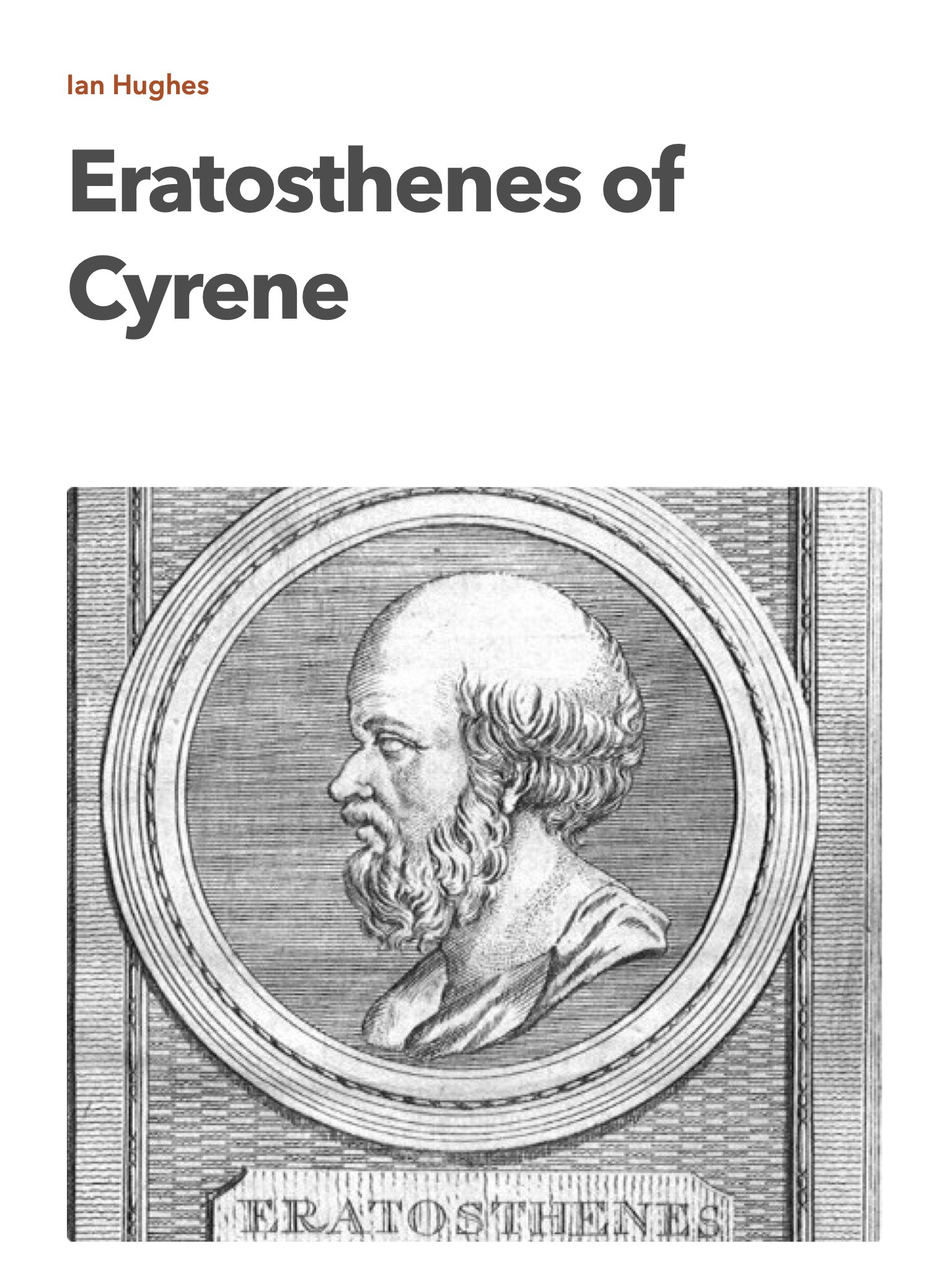
Eratosthenes of Cyrene (c. 276 –194 BCE)
Greek mathematician, geographer, poet, astronomer, and music theorist Eratosthenes of Cyrene (c. 276 –194 BCE) became the head of the Library at Alexandria and was rated the most versatile scholar of his time. He is best known for his remarkably accurate calculations of the Earth's circumference and the tilt of the Earth's axis. He is also credited with calculating the distance from the Earth to the Sun; inventing both the leap day and the discipline of geography; creating the first map of the world, incorporating parallels of latitude and meridians of longitude, and developing the 'sieve of Eratosthenes,' a method for isolating prime numbers. He wrote extensively, but only fragments of his work survived the destruction of the Library of Alexandria.)
The sidebar contains a link to a more detailed Biographical Sketch.
Sources:
Chambers Biographical Dictionary
Encyclopedia Britannica: Eratosthenes
Alfred Hiatt, Terra Australis and the Idea of the Antipodes
G. A. Mawer, Incognita: The Invention and Discovery of Terra Australis
William Smith, (ed.) Dictionary of Greek and Roman Biography and Mythology
O.H.K. Spate, The Pacific Since Magellan, Volume I: The Spanish Lake, p. 8
Avan Judd Stallard, Antipodes: In Search of the Southern Continent
The Geography of Strabo
David Stuttard, A History of Ancient Greece in Fifty Lives
Wikipedia: Eratosthenes