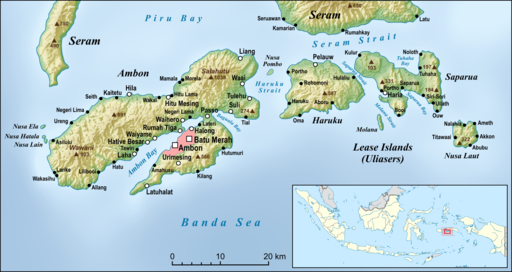
Ambon Island
Located off the southwestern coast of Ceram (Seram), the irregularly shaped Ambon is one of the chain of volcanic islands that encircle the Banda Sea. Around 51 kilometres long, the island is almost divided in two by the narrow, twenty-kilometre-long safe harbour (Ambon Bay), with a narrow isthmus connecting the smaller southeastern portion (Leitimur) to the larger Leihitu or Hitoe. While the island is mountainous, subject to earthquakes and has extinct volcanoes, hot springs and gas vents, there are no active volcanoes. Like the rest of the Maluku Islands, Ambon and Seram are part of Wallacea, separated by deep water from Asia and Australia without previous terrestrial links to either continent.
Ambon City lies on the bay's northern, eastern, and southern sides. Its safe harbour became a focal point in the region's spice trade, which brought the Portuguese to the island in 1512, Ambon became the centre of Portuguese activities in Maluku after they were expelled from Ternate in 1575. Thirty years later, after Steven van der Hagen's Dutch fleet took over the fort without firing a shot. Ambon became the Dutch East India Company's headquarters until 1619, when Jan Pieterszoon Coen secured a more centrally located base in Batavia.
With the Portuguese out of the way, the Dutch set about imposing a stringent monopoly of the spice trade, eliminating the English factory at Cambello in the Amboyna Massacre (1623). Apart from two brief interregnums during the French Revolutionary (1796 — 1802) and Napoleonic Wars (1810 —1814) when British forces occupied the island and a period of Japanese occupation during World War Ii, Ambon remained in Dutch hands until Indonesia became independent. Although a 1950 revolt by the Ambonese—many of whom had served in the Dutch administration and army and proclaimed an independent South Moluccan Republic —was suppressed by military action, guerrilla warfare continued in Ceram for over a decade. Many Ambonese fled to the Netherlands. More recently, ethnic tensions between Indigenous Ambonese and migrants from elsewhere in the archipelago and religious tensions between Muslims and Christians have placed Ambon at the centre of sectarian conflict across the Maluku Islands.