Brazil
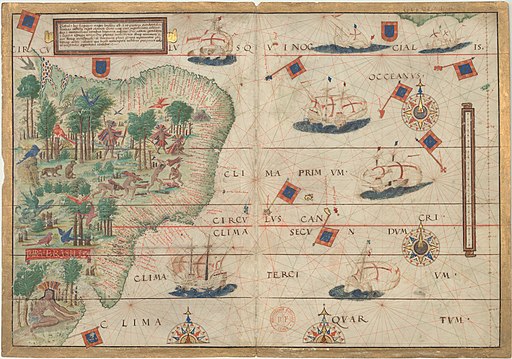
Occupying about of the continental landmass with a 7,500-kilometre coastline, Brazil is South America's largest and easternmost nation. With around one-third of the continent's population, Brazil shares 15,700 kilometres of borders with every other South American country except Ecuador and Chile. The country's name stems from brazilwood, a tree that produces a deep red dye highly valued by European textile imakers. The dyewood was Brazil's earliest commercially export, with thousands of tons delivered to European traders through the 16th century in return for trinkets and hardware.
In global terms, Brazil ranks:
- fifth-largest by area, behind Russia, Canada, China, and the United States;
- seventh largest by population;
- among the world's most multicultural and ethnically diverse nations , thirteenth in the world in terms of UNESCO World Heritage Sites and
- number one on a list of the world's seventeen most megadiverse countries.
in 1500. Through the subsequent colonial era, which lasted until 1808, the territory's official name was Terra da Santa Cruz (Land of the Holy Cross), but to Europeans it was more commonly Brazil, due to the brazilwood trade or the Land of Parrots.
During the Peninsular War, the Portuguese empire's capital was transferred from Lisbon to Rio de Janeiro in 1808, and the colony became part of the United Kingdom of Portugal, Brazil and the Algarves seven years later. Independence followed in 1822.