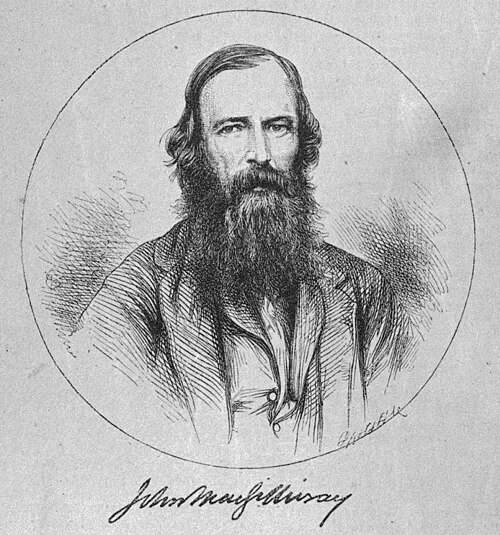
John MacGillivray
Placeholder page. More detailed content in preparation.
Aberdeen-born naturalist John MacGillivray (1821 – 1867), the eldest son of the noted ornithologist William MacGillivray, was active in Australia between 1842 and 1867, participating in three of the Royal Navy's surveying voyages in the Pacific.
Between 1842 and 1846, he served as naturalist on Captain Francis Blackwood’s HMS Fly, tasked with surveying Australia’s east coast, the Torres Strait and New Guinea.
In 1846, he was appointed naturalist on Captain Owen Stanley’s HMS Rattlesnake. This expedition visited locations including Port Curtis, Rockingham Bay, Port Molle, Cape York, Gould Island, Lizard Island, Moreton Island, and Port Essington. They also conducted surveys of Bass Strait, New Guinea’s southern coast, and the Louisiade Archipelago before returning to England in 1850.
A third voyage aboard HMS Herald took MacGillivray to Tristan da Cunha, Lord Howe Island, Dirk Hartog Island and Shark Bay before he was dismissed by Captain Henry Mangles Denham in early 1855.
While few details of the following years are certain, it seems he served as the secretary of the Horticultural Improvement Society in Sydney. He also visited the New Hebrides between 1858 and 1860 and returned to Sydney via Cape York in 1861. In 1862 and 1864 he published articles in Sydney newspapers. He then spent some time in Grafton in New South Wales’ Northern Rivers District before returning to Sydney at the end of 1866. MacGillivray was planning an expedition to Cape York when he died on 6 June 1867.
Sources:
- J. H. Calaby, John MacGillivray (1821–1867), Australian Dictionary of Biography
- Encyclopedia of Australian Science and Innovation: MacGillivray, John (1821 - 1867)
- Doug Herrington, Who was John MacGillivray? Birdlife North Queensland
- Wikipedia: John MacGillivray