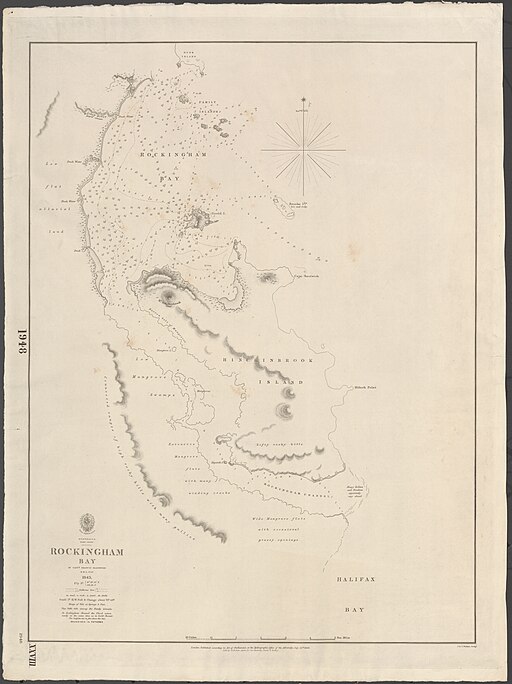
Rockingham Bay
Extending from Dunk Island and Tam O'Shanter Point to Hinchinbrook Island's easternmost extremity, Rockingham Bay opens onto the Coral Sea. Notable features associated with the bay and its shoreline include Girramay National Park, the town of Cardwell and Goold Island.
James Cook named the bay after the Marquis of Rockingham — England's Prime Minister from 1765 to 1766 — when the Endeavour passed through the area on 8 June 1770. Cook's Journal from Friday 8 June 1770 describes the bay thus:
Having passed Point Hillock, we continued standing to the North-North-West as the land Trended, having the Advantage of a light Moon. At 6 a.m. we were abreast of a point of Land which lies North by West 1/2 West, 11 Miles from Point Hillick; the Land between them is very high, and of a craggy, barren surface. This point I named Cape Sandwich; it may not only be known by the high, craggy land over it, but by a small Island which lies East one Mile from it, and some others about 2 Leagues to the Northward of it. From Cape Sandwich the Land trends West, and afterwards North, and forms a fine, Large Bay, which I called Rockingham Bay — The Marquis of Rockingham was England's Prime Minister from 1765 to 1766 — it is well Shelter'd, and affords good Anchorage; at least, so it appear'd to me, for having met with so little encouragement by going ashore that I would not wait to land or examine it farther, but continued to range along Shore to the Northward for a parcel of Small Islands — The Family Islands — laying off the Northern point of the Bay, and, finding a Channel of a Mile broad between the 3 Outermost and those nearer the Shore, we pushed thro'. While we did this we saw on one of the nearest Islands a Number of the Natives collected together, who seem'd to look very attentively upon the Ship; they were quite naked, and of a very Dark Colour, with short hair. At noon we were by observation in the Latitude of 17 degrees 59 minutes, and abreast of the North point of Rockingham Bay, which bore from us West 2 Miles. This boundry of the Bay is form'd by a Tolerable high Island, known in the Chart by the Name of Dunk Isle; it lays so near the Shore as not to be distinguished from it unless you are well in with the Land.
Following Cook's voyage, Rockingham Bay received several visits from voyagers investigating Northern waters, including Philip Parker King, who arrived on 19 June 1819:
We then entered Rockingham Bay and anchored at two miles off Goold Island.
On passing Cape Sandwich in the afternoon we observed several natives walking on the shore; and, upon our anchoring, a party was also seen collected round their huts, on the sandy beach at the west end of Goold Island; and near them were seven canoes hauled up above the tide mark; they had kindled a fire to attract our attention, but the day was too far advanced to allow communicating with them that evening.
June 20.
At daylight the following morning I was much surprised by being told that five canoes were paddling off to the cutter, four of which only held each one native, but the fifth being rather larger contained two.
On approaching the cutter they laid off until invited to come alongside; when they approached without the least alarm or hesitation, and made signs for something to eat; some biscuit was given to them which they ate and, unlike all other Australian savages, appeared to relish its taste. Some little persuasion was necessary to induce them to venture on board; but as soon as one mounted the ladder the others followed. Their astonishment was considerably excited at everything that they saw, particularly at our poultry and live stock. Fishing hooks and lines were gladly received by them; and in return they gave us their baskets and turtle pegs; they remained with us for half an hour; upon leaving the vessel they pointed out their huts and invited us by signs to return their visit.
As soon as they had left us Mr. Bedwell and Mr. Cunningham went to the islet off the west end of Goold Island, and on their way met two other canoes, containing three men, coming to the cutter from another part of the bay; after a short communication with our party they paid us the intended visit, and were soon induced to come on board, where they remained for half an hour without betraying the least fear or anxiety for their safety: before they took their leave we had clothed them with some damaged slops; and in order to give each something, the feet of a pair of worsted stockings were cut off to make socks for one, whilst the legs were placed on another's arms; a leathern cap was given to each of them, and thus accoutred, and making a most ridiculous appearance, they left us, highly delighted with themselves and with the reception they had met with.
As soon as they reached a little distance they began to divest themselves of their attire, and we had much amusement in witnessing the difficulty under which the wearer of a shirt laboured to get it off.
Their canoes were not more than five feet long, and generally too small for two people; two small strips of bark, five or six inches square, serves the double purpose of paddling and for baling the water out, which they are constantly obliged to do to prevent their canoe from sinking; in shoal water the paddles are superseded by a pole, by which this fragile bark is propelled. We endeavoured to persuade them to bring off some spears to barter, for they had no weapon of any description with them, but they evidently would not understand our meaning. In the evening our gentlemen proceeded to return these visits, at the spot which was pointed out by our morning guests: on landing they were met by the natives and conducted to their huts, where they saw the whole of the male part of this tribe, which consisted of fifteen, of whom two were old and decrepit, and one of these was reduced to a perfect skeleton by ulcerated sores on his legs that had eaten away the flesh and left large portions of the bone bare; and this miserable object was wasting away without any application or covering to his sores.
No teeth were deficient in their jaws; all had the septum narium perforated, but without wearing any appendage in it. The only ornament they appeared to possess was a bracelet of plaited hair, worn round the upper arm. An open wicker basket, neatly and even tastefully made of strips of the Flagellaria indica, was obtained from one of them by Mr. Roe, in which they carry their food and fishing lines; besides which each native has his gourd, the fruit of the Cucurbita lagenaria, which grows plentifully on all parts of the beach, and furnishes a very useful vessel to these simple savages for the purpose of carrying water.
At the north-east end of the sandy beach a fine stream was noticed, from which water might with facility be obtained. Near this stream Mr. Cunningham observed several of their ovens, similar to those used by the natives of Taheite. A circular hole is dug, at the bottom of which is placed a layer of flat stones, on which, after they have been heated by fire, the meat is placed; this is covered by another layer of stones, and over them they make a fire which very soon cooks their repast. In short, the natives of this bay seem to be much more ingenious and to understand better what is useful than the generality of their countrymen.
The bay was significant as the location where Edmund Kennedy's expedition began their ill-fated attempt to travel overland to the tip of Cape York in 1848.