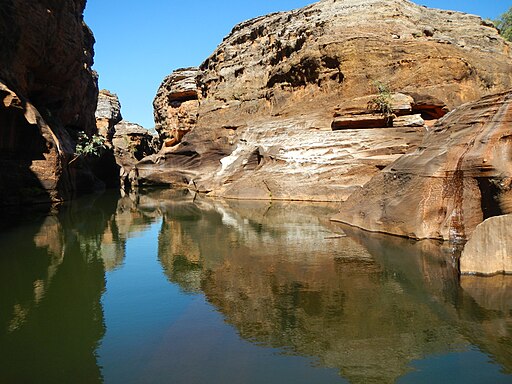
Cobbold Gorge
Situated 32 kilometres southwest of Forsayth, 60 kilometres south-southwest of Georgetown, 324 Kilometres southwest of Cairns, 362 kilometres west-northwest of Townsville and 290 kilometres west of Ingham in Agwamin/Ewamain Country, Cobbold Gorge is not as old as one might suppose — geologically or historically.
Although it sits in an ancient landscape — the sand and silt that formed the surrounding Hampstead Sandstones were deposited on an ocean floor around 1,700 million years ago — minor movements in the Earth's crust around 10,000 years ago contributed to the formation of what is, geologically, Queensland's youngest gorge, set in around 80 square kilometres of rugged sandstone formations surrounded by nineteen-metre cliffs that meant straying cattle were unlikely to make their way into the uplands.
Those considerations help explain the relatively recent — 1992 — discovery of an unobtrusive feature tucked away in the southwest corner of the 1284-square-kilometre Robin Hood station. No one felt inclined to investigate the area very closely. Graffiti on the sandstone cliff at the waterhole that forms the gorge's outlet – ‘J. E. CLARK 1900’ – indicates that the original owners visited the location around the time they took up the property. The Clark family occasionally returned to water cattle, as did members of the Terry family, who purchased the property in 1964.
Eventually, in 1992, Simon Terry decided to investigate the far end of the waterhole. What he found prompted a small-scale tourist venture that catered to around two hundred visitors in 1994. Current annual visitor numbers exceed ten thousand, largely accommodated three kilometres from the gorge across the Robertson River at Cobbold Gorge Village.
47.2 square kilometres around the gorge were declared Cobbold Gorge Nature Refuge in 2009.
Access to Cobbold Gorge is restricted to guided tours between the start of April and the end of October each year.