Darling River
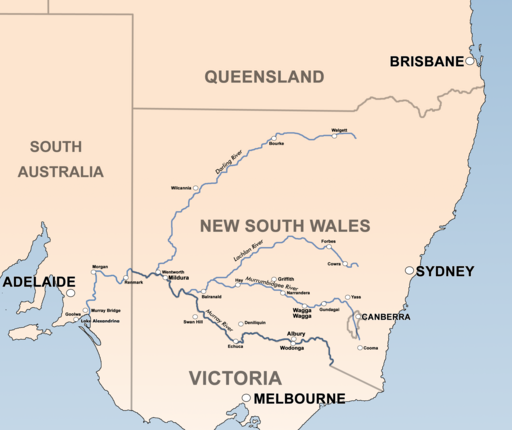
Australia's third-longest river, the Darling, flows for 1,472 kilometres from the junction of the Culgoa and Barwon rivers, between Brewarrina and Bourke in northern New South Wales, to its confluence with the Murray River at Wentworth. Add its longest tributaries: the Balonne, Condamine, Macintyre, Gwydir, Namoi, Castlereagh, and Macquarrie — all of which join the main stream north of Bourke — and the Bogan, Warrego and Paroo Rivers, which join the river lower down, and it becomes the continent's longest river system.
The easternmost of several headstreams in the Great Dividing Range near the Queensland-New South Wales–Queensland border, the Severn, becomes, successively, the Dumaresq, Macintyre and Barwon before joining the Culgoa to form the Darling; the other major tributaries in the river's 609,283 square-kilometre catchment undergo similar transitions.
However, despite the vast catchment, which represents more than one-twelfth of the continent's 7.692 million square kilometres, an annual average of less than 250 mm of rain across the basin means that the river often loses more water by evaporation than it gains from its tributaries. As a result, the river's flow is irregular and intermittent —the Darling dried up 45 times between 1885 and 1960.
Still, throughout the late 19th century, the river became a major transport route, as New South Wales graziers used it to ship their wool by shallow-draft paddle steamers from river ports including Bourke to railheads in South Australia.
Sources:
- Encyclopedia Britannica: Darling River
- Wikipedia: Darling River